Digest: r/myog: Sep 16 - Sep 23, 2026
Published: 5 days ago | Author: System
No posts in this digest period.
| ID | Type | Limit | Status | Last Update | Next Update |
|---|---|---|---|---|---|
| digest-myog | digest | 8 | Enabled | 5 days ago | tomorrow |
Published: 5 days ago | Author: System
No posts in this digest period.
Published: 1 week ago | Author: System
No posts in this digest period.
Published: 2 weeks ago | Author: System
No posts in this digest period.
Published: 3 weeks ago | Author: System
https://www.reddit.com/gallery/1vzufvz
Duplicated my beloved Patagonia Funhoggers and added some adaptations for the integrated belt and some extra panel details around the sides. My most complicated sew yet and without a pattern. Learnt a lot and have the same fabric in an off white to try again and make improvements
⬆️ 218 points | 💬 19 comments
⬆️ 116 points | 💬 13 comments
https://www.reddit.com/gallery/1w065zu
Made for a good friend’s 3 year old. The little straps are probably my fave. A nice break from making 95L load haulers!
Ultra 200X
UltraGrid
Venom mesh
Two interior sleeves for diapers and Cheerios.
Top flap with Vislon zipper for passport and phone.
Tiny little shoulder straps for tiny little shoulders.
⬆️ 103 points | 💬 16 comments
https://www.reddit.com/gallery/1w2ee7m
I discovered this sub and i thought to myself i have to try this.
This is my first time sewing and i have much to lern but is makes fun! Looking forward to make more stuff!
This bag is for my powerbank because i didnt like that it gets scratched so easily.
And i made it short on top so i can still read how much power i have left.
It is made from some to small underwear and an old shoppingbag ^^
Everything you guys make looks so cool. Thanks for the inspiration!!
⬆️ 131 points | 💬 15 comments
https://www.reddit.com/gallery/1w2sskv
Recently got back into climbing after 20+ years away and I needed a new rope bag. Design is based on my million year old Metolius rope bag with tarp. It’s my first time designing something without a pattern. Fabric came from our 17 year old tent that was recently retired.
I love how it turned out! I do have a strap for over shoulder carry, but mostly it just goes in my pack. It’s held up well over the last 2 months of climbing.
Learned all about bar tacks and French rolled seams on this project.
⬆️ 84 points | 💬 3 comments
https://www.reddit.com/gallery/1w2kh0c
⬆️ 58 points | 💬 9 comments
https://www.reddit.com/gallery/1w0r48u
Finished a new quilt for my partner. He has a down one, but will be hiking the Cape Wrath Trail in Scotland, which is notoriously damp, so I made a synthetic one for him.
It's a membrane 10 taffeta nylon and the insulation is Climashield Apex. There's a drawstring foot box with a partial zipper.
The whole thing weighs 22 ounces.
The material was tricky AF to work with, but I'm happy with the final product! The pattern itself is super easy, it's the fabric that was the challenge. I ended up putting tracing paper behind it while sewing to provide some stability and to keep my machine from eating the nylon. My first time with a zipper as well, I need to work on that.
It's 84" long × 55" wide (at the top, the bottom is 44")
⬆️ 69 points | 💬 11 comments
https://www.reddit.com/gallery/1w1y066
made a ~4.74x4.75” mini first aid pouch for paddle boarding!
Used ripstop and a waterproof zipper from RSBTR.
was inspired to try my hand at a zipper garage from u/Snuffvieh ‘s post [here](https://www.reddit.com/r/myog/comments/1vq5a14/made\_a\_nice\_and\_cool\_pouch\_for\_my\_30000\_mah\_power/). I read up a fair number of zipper garage posts online to study up on it. I had the opposite problem to them, mine ended up a little short and doesn’t cover the zipper all the way because it’s also turning the corner from the 3D-ness of the pouch. Fun first try, and I’ll be back to work on it more!
⬆️ 65 points | 💬 1 comments
Published: 1 month ago | Author: System
https://www.reddit.com/gallery/1vufbev
This is a quick follow up from my previous post. I took the advice of u/accidentOk5240 to use tissue paper as a stabilizer for the super light stretch mesh fabric. It worked like a charm! I've never seen stretch fabric this easily and had it lay this flat. Thank you for the advice. The community is awesome!
The last picture is a picture of the panel sewn with tissue paper on the left and without on the right.
⬆️ 270 points | 💬 21 comments
https://www.reddit.com/gallery/1vwpkvs
This is my first jacket attempt, super happy with how it turned out. It’s 1.6 oz Silpoly. I used the LearnMYOG UL Wind Jacket Pattern. Waterproofed the seams with 1:3 dilution of Gear Aid Seam Grip+Sil and mineral spirits.
I needed an ultralight hooded rain jacket for long trail runs, so I left off pockets. I did add mesh armpit gussets to try and vent some heat. I’m aware this isn’t breathable, but all my experience says nothing really breathes great, this is more about packing light and staying dry in remote backcountry areas in tough situations (if I’m pulling this out, I’m probably slowing down).
Wore it in the shower and seams didn’t leak! Success!
I’ve learned a lot from Reddit users since starting this journey last year, thanks for all the helpful advice that everyone has been willing to share.
⬆️ 190 points | 💬 16 comments
https://www.reddit.com/gallery/1vu5fg1
⬆️ 109 points | 💬 24 comments
https://www.reddit.com/gallery/1vt431a
Just finished this quick and dirty mini project of finally sewing a fabric cover for my blank pot cozy.
The insulation is some kind of aluminium (?) coated foam that was taken from a windshield cover. I’d double layered in both directions, so in theory it should also be possible to keep contents cool.
Fabric is a Cordura of unknown weight.
It’s designed to fit a 750ml pot or a 550ml pot with an additional collapsible cup and a drip coffee filter.
⬆️ 106 points | 💬 7 comments
https://www.reddit.com/gallery/1vydghk
For my camp kitchen to store and organize utensils for 8+ people - inspired by this $0.99 cutlery tray https://www.ikea.com/ca/en/p/smaecker-cutlery-tray-anthracite-10601459/
⬆️ 164 points | 💬 21 comments
https://www.reddit.com/gallery/1vso1id
Obviously heavily inspired by Pa'lante and Atom packs - I love their stuff.
Credit to u/nine1seven3oh for the very easy to follow instructions. This is the 40L frameless version.
⬆️ 80 points | 💬 8 comments
https://www.reddit.com/gallery/1vy26ha
I’ve been looking for a while for something to have as a personal reminder of my mom, Jill, who passed away 2 years ago in October. I finally decided to sew a fanny pack that I’d use often and add a personal touch of Jill.
If you knew Jill, you knew love by the way she treated you, but she also made sure and said it. She always said “love” as her goodbye and even had a love table in our house. I was able to digitize her handwriting from her journal with her signature “love” and put it on a leather patch. Now I will be able to carry her love with me wherever I go.
A few notes about the bag itself, this is my second fanny pack I’ve made and definitely still learning. The water bottle pocket is detachable and can be attached to either side of the hip belt. It also has a divided pocket on the inside along with an interior zippered pocket.
⬆️ 111 points | 💬 8 comments
https://www.reddit.com/gallery/1vve9wo
When I'm testing out a pattern l either like to make a test bag out of tyvek or remnants that I get from local sail lofts and canvas shops. It's a low cost way to make sure everything goes together as it should and the proportions look right. I'm getting better at visualizing how it will look while patterning, but sometimes I still flub.
This little bag is a variation of my larger frameless pack design. I scaled it down so that it's about 18L and has a basic flap lid rather than a roll top. It also has flat elastic front and side pockets rather than larger darted pockets with cord channels. After trying and failing to sew the stretch fabric, I took some advice from this community and used tissue paper as a tear away stabilizer which worked beautifully. I didn't feel like tearing my hair out using the new method.
Since this pack is supposed to be a fairly quick make and isn't meant to hold a ton of weight, I decided to try out a basic webbing strap, rather than building padded shoulder straps. To help make the straps feel softer, I bound the edges with herringbone nylon tape. This worked well. Rather than making a reinforcement triangle, I copied Patagonia and used a bit of 3/4" webbing wrapped around the main strap and then sewn into the seam. It's definitely a faster construction method.
⬆️ 93 points | 💬 6 comments
Published: 1 month ago | Author: System
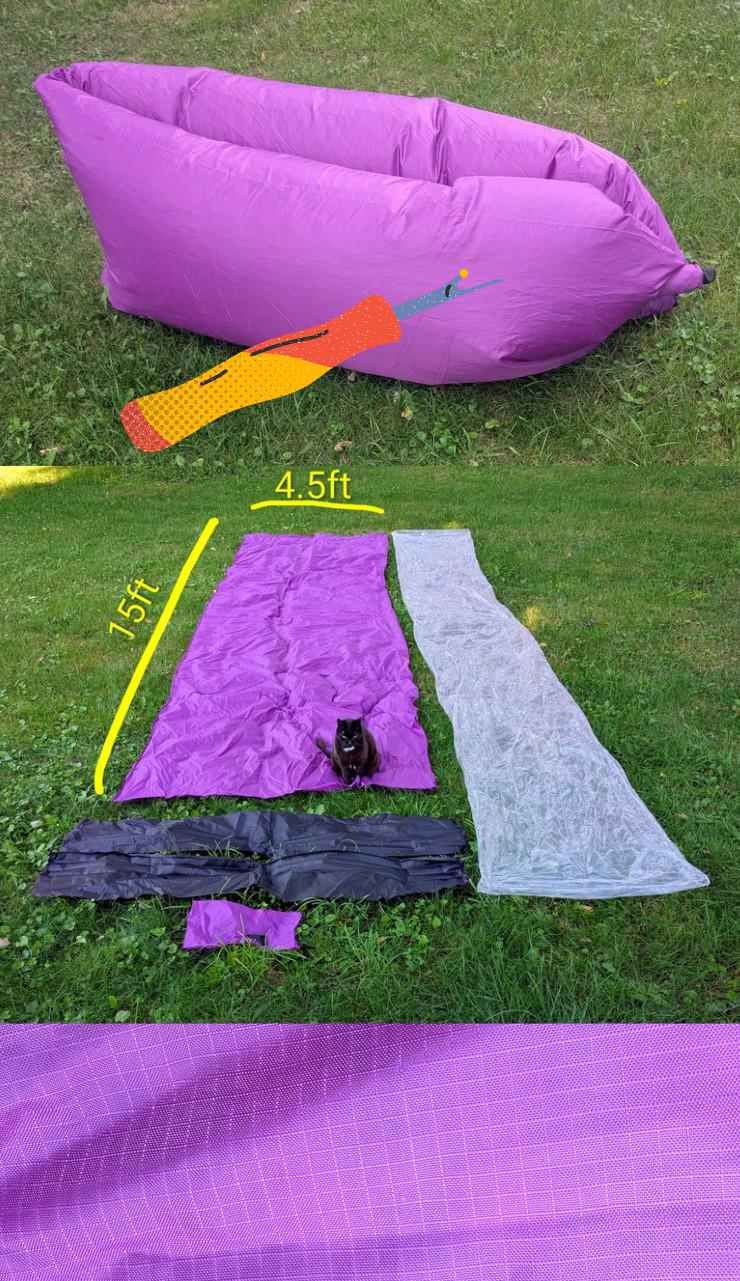
1 thrifted air sofa = ~67.5 sq. ft of ripstop + some thick nylon + 1 side release buckle + the world's longest pack liner. They're a common thrift find in my area, I guess the trend died. Usually under 8 bucks because nobody in the back knows what it is. Not all of them are ripstop, but many are. Thought I'd share for anyone else making gear on a budget. Cat for scale.
⬆️ 44 points | 💬 4 comments
https://www.reddit.com/gallery/1vmll0s
Weight: 0.2oz
Off the dome, i just picked up a sewing machine yesterday so I am super new at this! Thought of making this since I own a DCF version made by someone professionally but my problem is that it really doesn’t diffuse much or any at all… The tiny DCF is now a earbuds/cables holder.
⬆️ 199 points | 💬 6 comments
https://www.reddit.com/gallery/1vq5a14
It’s cute, I like it, but I have some issues with it as well and will probably remake it eventually haha
probably not tho
⬆️ 140 points | 💬 13 comments
https://www.reddit.com/gallery/1vohc5p
Saw a Reddit post a while ago and really liked the idea of a bigger work surface so I went ahead and made this from mostly scraps and leftovers :)
Hope this belongs here!
⬆️ 149 points | 💬 14 comments
https://www.reddit.com/gallery/1vpwioe
This weekend’s project: dry bags made from 20D ripstop nylon, TPU coated on both sides.
I’m a bit paranoid about electronics getting wet since I trashed my phone on the second day of a three week vacation during a kayaking trip. That’s why I always wanted a small dry bag for phone, power bank, wall charger and head phones.
Now I made one myself. No-sew heat bonded with ~5mm seams (never doing heat bonding on such narrow seams ever again!), using a regular clothes iron. I had experimented with this before, but this fabric was especially sensitive to temperature, pressure and duration. Turned out well anyways, it’s 100% waterproof, if rolled up without folds.
I don’t know how to create captions for the pictures, so:
Pictures 1/2: dry bag unrolled/closed,
Picture 3: detail of finished bonded seam,
Picture 4: creating “basting points” on a seam,
Picture 5: series of basting points, each one indicated with seam clips,
Picture 6: bonding of seam with the edge of the iron. After that, the seam was folded over and bonded flat. I used a Teflon fabric to avoid the tpu from sticking to the iron, it also adds an interesting texture to the seam itself
⬆️ 164 points | 💬 14 comments
https://www.reddit.com/gallery/1vry7nq
I've been working to switch careers into bag design, and I needed to bolster my portfolio. I had no projects that I could reference that I took all the way from pencil sketch to finished product. A family friend DM'd me to request a backpack for his first year of college, and I took that as an opportunity to design a backpack from scratch.
He provided me with reference pics of bags he liked, features he wanted, and a colorway. His preferred color scheme was mostly black with subtle blue highlights. However, I didn't want to make the bag overly paramilitary-looking. So I commissioned a graphic designer friend to make the design more playful with graffiti art of Sub-Zero from Mortal Kombat.
This was a months-long project and one of my hardest ever. Pencil sketching is not my strong suit, but I really needed this for job applications. I spent hours on the initial sketch, trying my best to give it sensible 3D depth and layout.
I designed a pattern in CLO 3D and simulated on an avatar with similar proportions to the client. I didn't export / print the entire pattern, since most panels were rectangular. I only printed the curved ones, choosing to hand-draft the others for convenience.
I used a 1050 Denier ballistic nylon for the main fabric, 400D ripstop nylon as a secondary fabric, and 70d ripstop nylon for the liner. I chose Duraflex hardware wherever possible, e.g. D-rings, side-release buckles, triglides.
Sewing was mostly straightforward, except for the cinch-tops on both the water bottle holders and the main bag opening. I also didn't know where the cross-chest strap would land until after wearing the bag. I didn't have any Duraflex removable sternum sliders on-hand, so I sewed the chest strap directly to the shoulder straps; that's one thing I would redo if I had more time.
I dye-sublimated the Sub-Zero art and artist's tag onto some dye-sub synthetic fabric and backed it with upcycled racing-sail fabric. It attaches with snaps so the client can take it off (he doesn't actually like Mortal Kombat and didn't even ask for this lol).
Part of design portfolios is iteration, so I forced myself to sit down and sketch some "postmortem" drawings to document the lessons I learned from making this bag. They've been helpful reminders so far.
Overall, I'm quite happy with this one and proud of the results. Happy to answer any questions about material, process, design, CLO 3D, etc.!
⬆️ 43 points | 💬 0 comments
https://www.reddit.com/gallery/1vmm8q0
When I was doing metalwork and making tools, often I would get an idea that wasn't within my order book and was outside my normal style. I would almost always make that project, and it would always push my skills and creativity forward. This is one of those projects. I decided that I wanted to take the pattern that I built for a 40L pack and convert it into a classic looking pack with panel loading access.
Usually when I update a pattern I am very thoughtful. I think through all the potential issues, and when I go to sew the bag, no real problems arise. Well, I rushed this one, and I don't know if I have ever had to seam rip this much before. I had panels that were just slightly too long. I forgot to add webbing. I added seam allowance where I didn't need to. Etc.
Overall I am very happy with how it came out. The panel loading is functional. The panel has a #10 zipper on either side with storm flaps and a big velcro cover over top. The straps have load lifters to take some of the stress off of the velcro and the zippers. They need to be unhooked using the g-hooks to access the panel.
I really like the water bottle pocket design. Since this is a classic looking pack, I didn't want to have pockets that were really "balloony." Instead of the standard pleated pocket I usually use, I made a pocket with a single pleat that I topstitched at the pleat, so that it would lay flat when it wasn't filled.
There are a few things that could have gone better. I fully intended to add compression straps to the sides of the pack. Unfortunately I forgot until I was too far down the build to go back to add them in. I really like the design of the lid, but unless the pack is fully filled the flap is quite large. I think I could downsize it in the future (maybe).
The pack is made out of 1000D Cordura and ballistic nylon from Rockywoods Fabric, and Venom Gridstop from Ripstop by the Roll.
⬆️ 81 points | 💬 12 comments
https://www.reddit.com/gallery/1vq5ees
⬆️ 115 points | 💬 13 comments
Published: 1 month ago | Author: System
https://www.reddit.com/gallery/1vklkqy
I originally designed the pattern and handmade the first sample about 2 years ago in Clo3D and with each new version I’ve added more functional features - this latest version has an invisible ventilation zipper on the inside of the leg.
Some of the other features include:
My favourite feature is definitely the side pocket. Spent SO much time integrating the shape into the design. Really wanted to challenge myself and make a piece of outdoor gear that was vibrant and pretty while also being super functional for warmer weather climbing and hiking.
I think one thing I may change in my next version is hiding the elastic leg pulleys inside the pants instead of outside so the pants are a little more streamlined but other than that I’m super happy with the progression.
I know this wider leg fit isn’t for everyone but I love the airiness and freedom of movement I get when bouldering, sport climbing and hiking.
I made a video on my page recently with more info about the pants too: https://www.instagram.com/p/DbtUGx7oyDL/
Would love to hear your feedback!
⬆️ 875 points | 💬 55 comments
https://www.reddit.com/gallery/1vjb8v4
⬆️ 131 points | 💬 6 comments
https://www.reddit.com/gallery/1vk138s
⬆️ 108 points | 💬 5 comments
https://www.reddit.com/gallery/1vhca07
Ordered Amazon grosgrain because I didn't want to wait for shipping. Ended up ripping out the strap and redoing it because it looked so bad. Pictured is the same strap with 1" grosgrain from Amazon vs. RBTR 1" grosgrain. The cheap stuff buckles a bit on concave edges.
⬆️ 56 points | 💬 17 comments
https://www.reddit.com/gallery/1vllmyg
Built this for the PCT and figured I’d share how it turned out now that the trail is done. This was not hard and my specs are below:
80” × 54” × 44”
7D inner / 10D outer (3 yards each)
16 oz of 900 FP down
13 horizontal chambers
~2.5” baffles (buy 3.5”)
Sewn footbox @ 17"
626g / 22.1 oz finished @ less than 200.00$
It worked great through April/May Sierra snow and eventually became too warm in parts of Oregon (June) and central Washington (late June / July). 80% of the time I cowboy camped.
It also compressed surprisingly well and dried quickly.
The only real issue was some feather/quill poke-through, and interestingly it only happened through the outer 10D. I never had feathers puncture through the 7D inner. I patched the few spots that needed it and kept moving.
Overall, pretty stoked with it. 22 oz finished, survived the PCT, kept me warm, and packed well in a 37L palante.
Never sewed beforehand and bought a sewing machine at a thrift store. I used ChatGPT for my how to instructions.
Now it desperately needs a wash 😂
⬆️ 105 points | 💬 12 comments
https://www.reddit.com/gallery/1vlm581
I’ve finally gotten around to finish sewing a backpack, for which I had the fabric panels already cut and lying around for quite some time but didn’t get to it. Now that it’s done, I’m really happy about it, despite some minor flaws.
The pack it’s about 35ish litres in volume at a weight of 705g in this configuration, so without a hip belt. I couldn’t find the time to make one, so I used one of a previous pack in combination with the provisional lumbar pad. The weight doesn’t include the thumb loops, because they’re detachable and only used when I don’t have a shoulder strap pocket and a bottle holder attached to the straps.
The fabrics i used are x-pac x21 rc, a lightweight 4-way-stretch mesh, a thin 3d air mesh for the trampoline and some regular 3d mesh for straps and the lumbar pad.
The frame is made from two 12*2mm flat strips made from pultruded carbon and they’re inserted into sleeves that are made from folded nylon webbing. They’re held in place with a Velcro tie wrap, because I also haven’t gotten to make an x-shaped sleeve to replace it.
The shoulder straps are connected to the body with a single silk clip and are adjustable. Unfortunately, i made some measurement mistakes on that construction, which lead to the size range of 47-65cm back length. Lucky for me, I need a length of 48cm…
Before you ask: no the body doesn’t shift left or right because the load lifters stabilise it.
And there’s another mistake I made, the load lifters aren’t connected to the frame. This way they only work as desired, if the pack is filled high enough so the contents help push the body into the frame. Nonetheless, the frame diverts the weight onto the hip belt just as it’s intended to do, making the pack as comfortable to carry as I hoped it would.
I already tested it on an overnighter last weekended and it performed very well with ~9-10kg load.
All in all, I find it to be a successful experiment, especially because this is my first framed pack and there are not many existing packs with an x-frame construction that could serve as examples for how to construct the frame.
⬆️ 56 points | 💬 7 comments
https://www.reddit.com/gallery/1viyuo1
Made a combination chest/hip bag for fishing a couple years ago. Decided to make a mini one just for fly fishing. I have a couple different methods to carry my net, most often it's worn like a sling, but sometimes I slide it in between the fanny pack and my body, so I am experimenting with a unique carry option in the form of a pocket that unzips top and bottom. We'll see how that works out when not in use for the net, I figure that could just be an exterior pocket using just the top zip.
Might have used a bit too heavy material on a small bag like this because the seams aren't staying unfolded, but hopefully breaking it in will help there.
⬆️ 73 points | 💬 9 comments
https://www.reddit.com/gallery/1vkaf8o
From worn gym bag to up-cycled fanny pack.
⬆️ 31 points | 💬 1 comments
Published: 1 month ago | Author: System
https://www.reddit.com/gallery/1vfc9e6
I wanted a quick-ish way to test colorways using fabrics I own, so that I wasn't tempted to buy more fabric for upcoming projects. I whipped up a simple pouch pattern in CLO 3D to test some colorways based on the approximate colors and basic textures of some real fabrics i had on hand.
The idea was that I can make a full-sized backpack from a colorway once I've made a pouch with the same elements.
These pouches were meant to be medium-quality, quick-and-dirty test bags, but I ended up liking them enough to develop them into usable everyday cross-body bags.
I didn't choose both colorways from the CLO model, opting for a brown, orange, and black combo for my second build.
I love the aesthetics of them, and the size is perfect for phone, keys, wallet, sunglasses, and EDC stuff like lens wipes. I can even fit a book in the main pocket.
After some wear testing, I can say that the usability is kind of bad. The snap flap that seals the main pocket is annoying to fasten, and the rear pouch is almost totally inaccessible while wearing the bag. The G-hook grips the webbing so tightly that nothing will fall out, which is nice.
A fun project overall, so I wanted to share. Happy to answer any questions!
⬆️ 223 points | 💬 15 comments
https://www.reddit.com/gallery/1vdezi3
I couldn’t find much info on making an insulated jacket so thought I would write mine up.
Pattern is mostly learn myog ultralight windproof. I essentially made the jacket 3 times for each layer. Added a chest pocket and popper at the bottom to allow for the two way zip. If I made another version I would try alter the hood to make it able to go over a climbing helmet but otherwise pretty happy with it.
Outer Ripstop I picked up in Japan otherwise all fabrics and accessories were from Adventure Xpert
Climashield Apex 167 for body and hood
Climashield Apex 133 for sleeves
Unknown lightweight windproof ripstop for outer
7D Soft Ripstop fabric for the lining
Final weight 361g
⬆️ 79 points | 💬 10 comments
https://www.reddit.com/gallery/1vex58z
⬆️ 105 points | 💬 3 comments
https://www.reddit.com/gallery/1vcb2ra
Here are my second and third MYOG projects, both using patterns from @Prickly Gorse and materials from @ Monkey Puzzle Fabrics in Aus.
First is the 8 ltr Trail Running pack and second is the 40l frameless hike pack.
A steep learning curve on both bags but very happy with the results.
The main mod on the 40l frameless was sewing the hip belt to main pack rather than removable that proved pretty tricky but turned out well. I used a 4mm core flute as the slide in frame with lightweight aluminium section top and bottom that fit snug to the centre stay. The idea was to have the most direct connection between the hip belt and load lifters which seems to have worked pretty well.
Currently working on the Prickly Gorse 25l day pack which in hindsight would have been a better second MYOG project as it is less complex but where's the fun in that!
⬆️ 153 points | 💬 4 comments
https://www.reddit.com/gallery/1vaasmt
I thought some of you might appreciate this slightly unusual backpack project.
A mate recently asked me to design and build a backpack system to carry a stainless steel keg and gas bottle. It was a fun challenge because the main problem wasn't just creating a bag large enough to fit the components — it was figuring out how to manage the weight and stresses created by carrying a full keg.
A lot of thought went into the structural side of the design. I was particularly concerned about long-term stress on seams, thread strength, and avoiding points where all the load would be concentrated in one area.
To address this, I built the back panel, base, and shoulder straps as one continuous piece of fabric rather than relying on multiple joined sections. This reduced the number of high-stress seams and created a more direct load path.
I then reinforced the structure with two lengths of mil-spec webbing running continuously from the tips of the shoulder straps, down the back panel, underneath the base, and into the bottom seam, where they were secured with bartacks.
The goal was to have the webbing carry the majority of the load rather than relying purely on fabric and stitching to handle the weight.
It was one of those projects where the finished piece looks relatively simple, but the interesting part was hidden in the construction decisions that make it strong enough to do its job.
I'd be interested to hear how others approach load paths and reinforcement when designing soft goods for unusual or heavy payloads.
⬆️ 184 points | 💬 21 comments
https://www.reddit.com/gallery/1vdszih
I don't have a sewing machine. I made this bag with paracord and thin nylon fabric. I used the shoulder straps from my hiking backpack and designed and 3d printed the hooks. The idea was to maximize the payload I could carry in a carry-on backpack. I tested it during my trip to Japan. It looks really ugly, but it carries the load remarkably well. It is very lightweight of course.
⬆️ 89 points | 💬 5 comments
https://www.reddit.com/gallery/1va06vi
⬆️ 126 points | 💬 4 comments
https://www.reddit.com/gallery/1v0q8yp
⬆️ 118 points | 💬 3 comments